
A client asked me yesterday if they should be eating breakfast.
Here’s my honest take on breakfast skipping and what the evidence says.
Firstly the clue is in the name. Breakfast is simply the point at which you break your overnight fast, whether that’s at 6am or when you finally sit down with a cuppa at the office.
For most people, there’s no solid evidence you need to eat the minute you wake up. But here’s where it gets interesting. When researchers pooled the randomised trials (BMJ, 2019), breakfast eaters didn’t lose or gain any meaningful extra weight compared to skippers.
So the old “kickstarts your metabolism” line doesn’t hold up. The morning calorie‑burn difference is just your circadian rhythm, not the meal.
Where breakfast does matter is what happens later
If you suddenly feel ravenous because you’d normally have eaten by now, there’s a high tendency to grab energy‑dense foods rather than nutrients.
So while breakfast skipping is not the end of the world, it could spike your blood sugar.
And that spike often surprises people who assume, “I haven’t eaten for ages, surely my body will burn that food quickly.”
But your body isn’t a vacuum cleaner. After a long fast, certain hormones and fuels are still in “overnight mode”, and that can temporarily get in the way of how smoothly your body handles the next meal.
Here’s the simple version:
1. Overnight, your body releases fatty acids for fuel.
2. Those fatty acids stay elevated for a while after you wake.
3, Elevated fatty acids make insulin a bit sluggish — not broken, just less effective.
4. So when you finally eat, your blood sugar rises more sharply because your body is still transitioning out of fasting mode.
That’s all “blunted insulin response” means: your body is temporarily slower at clearing glucose. Most people handle this fine. Some (especially with insulin resistance, NAFLD, PCOS, or fatigue issues) feel it more strongly.
Zoom out and another piece matters: breakfast delivers a disproportionate amount of daily nutrients — roughly 24% of fibre, 32% of iron, and 30% of calcium — most people don’t make that up later.
The honest answer:
If you’re skipping breakfast and feel fine, your body probably suits it. If you skip breakfast and feel rough, foggy, or ravenous by 11am, that’s a signal worth listening to.
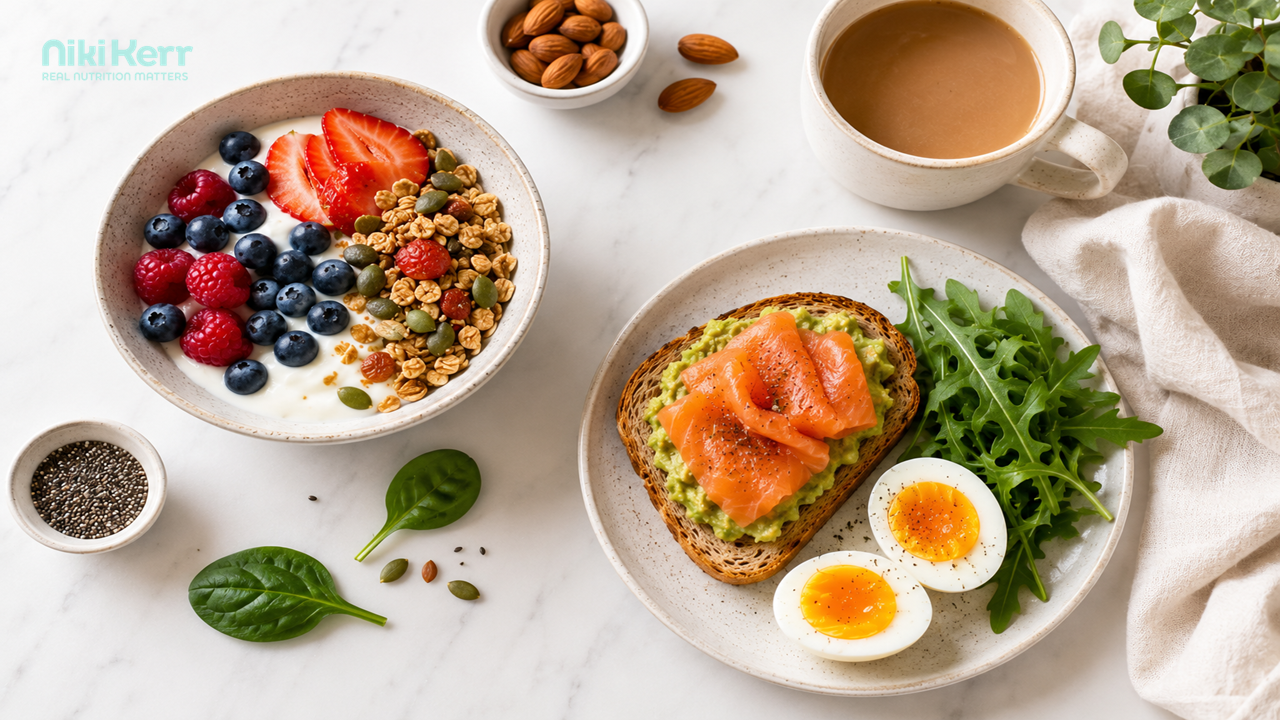
And if you do eat breakfast, what you eat matters more than the fact you eat it. Aim for 20–30g protein, 8–12g of different types of fibre, healthy fats, slow‑release carbs.
(Not typically found in a bowl of Coco Pops or a custard Danish).
What’s your relationship with breakfast — supportive, chaotic, or non‑existent?
For more simple science based facts see our Blogs
#NutritionMatters #Breakfast #NutritionScience #MetabolicHealth #BehaviourChange #HealthyHabits

