
THE PROBLEM WITH SUGAR…
Sugar is one of those subjects that seems to generate more heat than light.
I remember one of my professors at university referring to it as the new cancer, controversial language, (especially at a time when so much research was influenced by the sugar industry) while others argued the only clear evidence we had then was that sugar damaged teeth.
And even today, depending on who you ask, sugar is cast as the devil incarnate, a harmless pleasure, addiction in disguise, or something we should all simply eat “in moderation.”
If you’ve ever hidden the chocolate wrapper from the bar you ate on the way home from the supermarket, or felt the need to explain the empty biscuit tin, this article is for you. Quite frankly, most of us have been there.
Because the real story about sugar is not moral at all.
It’s not about being “good” or “bad” with food, nor is it simply about self-control.
It is about biology, behaviour, and the food environment we now inhabit.
But as I said earlier, the problem with sugar isn’t just sugar.
The evidence does not suggest that one sugary food causes diabetes or any other metabolic disorder. It suggests that habitual excess free sugar — especially from sugary drinks and ultra-processed foods — is linked with weight gain, poorer metabolic health, reduced insulin sensitivity, fatty liver risk and higher type 2 diabetes risk.
Once excess sugar becomes part of a metabolic pattern, the issue is no longer simply empty calories.
Over time, high intakes are associated with:
> Poorer blood glucose control — because the body keeps having to respond to repeated rises in blood sugar.
> Reduced insulin sensitivity — meaning cells may become less responsive to insulin, so the pancreas has to produce more to manage glucose.
> Higher triglycerides and fatty liver risk — particularly when excess sugar includes fructose-containing sugars, much of which is processed through the liver.
> Weight gain and visceral fat — especially when sugar arrives in forms that do little to satisfy appetite.
> Increased type 2 diabetes risk — most consistently seen in the evidence around sugar-sweetened beverages.
Excess sugar does not “give you diabetes” overnight.
But a high-sugar pattern, particularly from drinks and ultra-processed foods, may push the body towards insulin resistance, the metabolic state that often comes before type 2 diabetes.
And once you understand how those forces collide, much of what can feel confusing; cravings, food noise, or that pull towards something sweet after a long day — starts to look a lot less mysterious.
Because here’s the first thing worth saying plainly:
No one is weak or naughty because sweet foods appeal to them.
We are biologically primed to notice sweetness.
Historically, sweet foods often signalled safe, energy-rich nourishment. Breast milk is sweet. Fruit is sweet. For much of human history, sweetness often pointed towards survival, while bitter might mean poison.
That attraction did not arise by accident. And it turns out the body takes sweetness far more seriously than most of us realise because sweetness is not just something experienced on the tongue.
It is a signal.
- Your gut has sweet-sensing receptors.
- So does the pancreas.
Long before nutrition labels and blood sugar apps, the body evolved systems designed to detect sweetness and prepare for incoming fuel.
When something sweet arrives, the body may begin priming glucose handling, gut hormones, digestive responses and appetite signalling.
Sweet taste is doing far more than delivering pleasure. It is part of a communication system. Even appetite hormones influence how sweetness is experienced.
- Leptin, associated with satiety, can dampen sweet responses.
- Endocannabinoids — part of the same system linked to the “munchies,” can amplify them.
That matters, because it reminds us appetite is not a simple test of willpower.
Biology has a vote.
And yet biology is only part of the story.
Because while we may be born ready to like sweetness, modern life has taught us to expect it everywhere.
High-sugar cereals such as Froot Loops, Frosties and chocolate-flavoured pops can provide around 12–18 grams of sugar in a typical 40g bowl, approaching — and sometimes exceeding — two-thirds of a child’s recommended daily free sugar limit.
Flavoured yoghurts can easily contain double the sugars found naturally in plain yoghurt.
Coffee-shop drinks that look innocent can deliver sugars closer to dessert than drink.
And snack bars positioned as health foods often wear a halo they do not deserve. Even the humble flapjack — yes, oats are a source of fibre — can become confectionery in disguise when bound together with syrups and sugars.
We often hear comparisons of weight related health problems today vs previous decades and it’s complex but immediately obvious that dining out and desserts once saved for special occasions are folded quietly into daily life.
And layered on top of all that, something more emotional.
- The biscuit after a difficult meeting.
- Chocolate because you’ve “earned it.”
- Something sweet because the day has felt heavy.
That is not just hunger. Often, it is learned comfort and here the science gets unexpectedly fascinating.
Research suggests sweetness may do more than generate pleasure.
In infants and children, sweet taste has been shown to blunt distress and reduce pain responses.
Not symbolically.
Physiologically.
That appears to involve some of the body’s own calming pathways. Which raises a striking possibility:
Perhaps sweetness has long carried not just a signal of energy… but a signal of relief.
And suddenly old cultural rituals start looking different.
The sweet cup of tea offered after a shock.
Giving a distressed child something sweet.
Food as soothing. Not merely sentiment. Possibly biology echoed in culture.
And maybe that matters, because many adults still use sweetness in exactly that way — not for hunger, but for comfort. But this soothing effect isn’t universal. It appears weaker in children with depressive symptoms and in children living with obesity — groups in which reward and stress systems may already be dysregulated. In plain English: some people use sweet foods for comfort yet get less comfort from them, which can drive a cycle of seeking more sweetness for diminishing returns. And repeated heavy sugar exposure may blunt this soothing effect further. A self‑soothing strategy that becomes self‑defeating.
But here is where modern food changes the picture.
Because foods built around refined sugars do not simply tap ancient preferences. They can exaggerate them.
Sweet foods activate reward circuitry involved in pleasure, motivation and wanting. Again, not because sugar is literally a drug, (a comparison I think is often overblown).
But because some ultra-processed foods can push natural reward systems harder than nature ever intended and that may help explain something many people recognise:
You can be physically full…
and still want another biscuit.
That is often not hunger.
That is reward biology meeting clever food engineering – ‘The Bliss Point’
And this is where the problem with sugar starts to look much bigger than too many calories.
Because sugar itself is not the villain.
Sugar is carbohydrate – Carbohydrate is fuel – Glucose is a normal and necessary energy source.
The issue is not sugar existing.
- Form.
- Dose.
- Speed.
- Context.
An apple and a sugary drink may both contain sugars.
But they do not arrive in the body in remotely the same way. One comes wrapped in fibre, water, structure and nourishment. The other may arrive fast, intensely rewarding and easy to overconsume, activating a very different biology.
And perhaps this is where modern diets get people into trouble.
Not because sweetness is inherently dangerous.
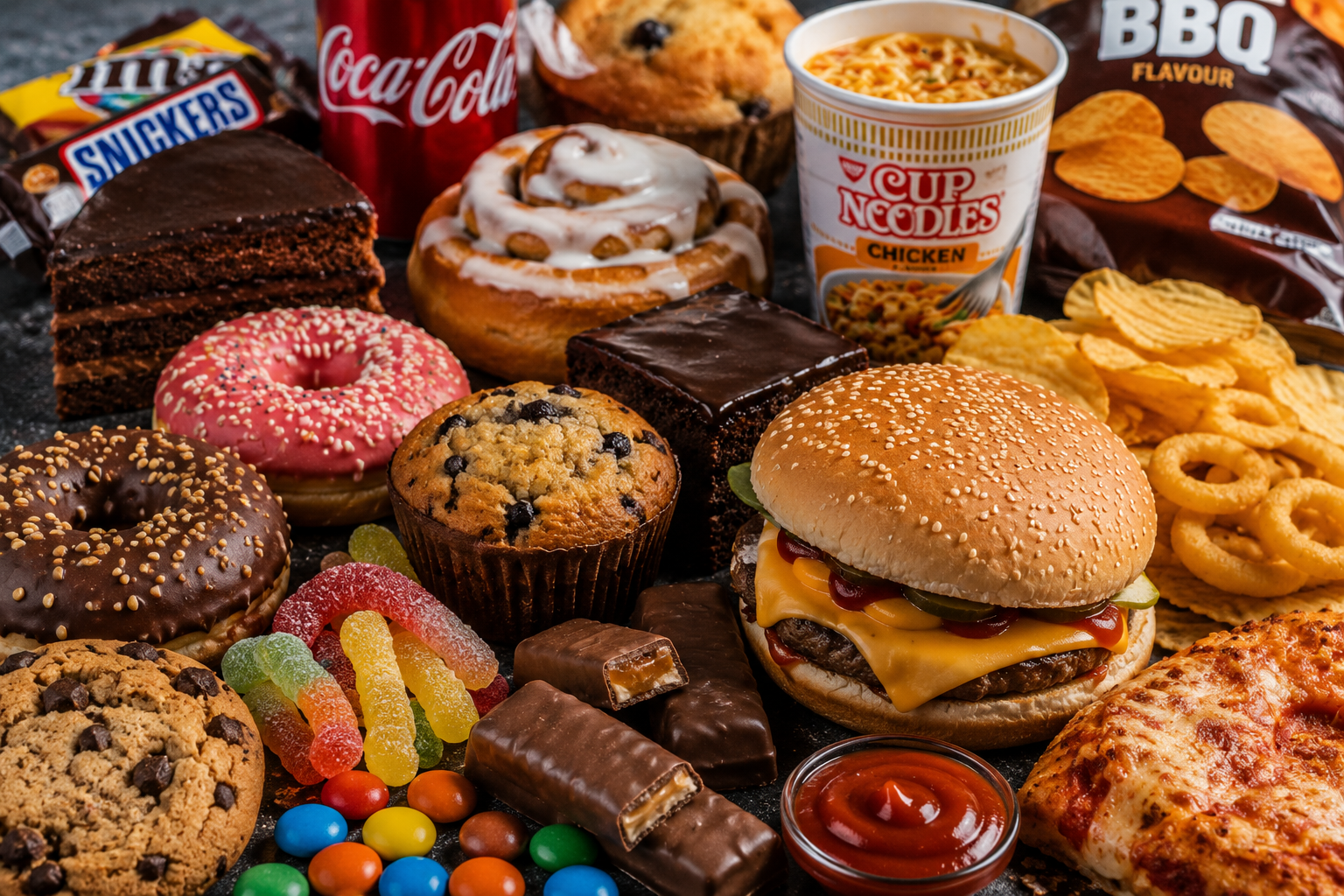
But because many people now live in an environment where highly sweet, low-nourishment foods are cheap, available, engineered to be hard to stop eating and often tied up with emotion.
And this is where empty calories deserves more scrutiny.
Because that phrase can sound trivial.
It isn’t.
Empty calories do not simply mean calories that “don’t count.”
They mean 4 Kcal/g of energy arriving without much of the fibre, protein, micronutrients or satiety that help regulate appetite, build and nourish the body.
And when too much of the diet is built from foods like that, a strange paradox can emerge:
Overfed… but undernourished.
Full… yet still hungry.
Enough energy.
Not enough nourishment.
And that matters because undernourishment does not only mean too little food.
It can also mean too little nutrition inside plenty.
This is where excess sugar can begin displacing foods that bring something the body actually needs.
- Vitamins and minerals.
- Fibre.
- Protein.
- Satiety.
- Metabolic steadiness.
And over time, that pattern may begin to disturb the systems meant to regulate appetite itself.
Frequent high exposure particularly in ultra-processed dietary patterns may contribute over time to dysregulated satiety signalling.
Put simply:
Sugar can soothe hunger briefly… and it can certainly help us consume foods that might otherwise seem unpalatable (think blackcurrants, sharp, packed with vitamin C but often sweetened heavily).
While quietly training appetite to expect more.
That is a very different message from “sugar is addictive.”
And a far more useful one.
Because it means cravings are not destiny.
Preferences can shift | Habits can be reshaped | Taste can recalibrate
Not through punishment.
Through understanding.
And perhaps that is the real point.
The goal is not to stop enjoying sweet things.
It is to stop being governed by them.
Because the real problem with sugar may not be sweetness itself, but what happens when ancient biology meets a food system designed to keep pressing the same buttons.
If you want more clear, evidence-led insight into how your body actually works — so you can make decisions that translated into real life and last – subscribe and follow along.
#Sugar #FoodNoise #Appetite

